01
Live CPD log
Add entries in real time and review your development on a timeline with smart filters.
CAPTURE LEARNING
A consolidated view of ongoing CPD activity and alignment to the APM Competence Framework (3rd edition), demonstrating sustained professional growth and reflective practice.
Hours needed before 30 Sep 2026
This page provides a comprehensive view of continuing professional development activities and competence alignment with the APM Competence Framework (3rd edition). It brings together a detailed CPD activity log, reflective themes, and a structured summary of key competence areas.
Take control of your professional growth. Record CPD, assess your competence against the APM Framework, and connect your learning to supporting evidence — all in one place.
Open CPD AppSix integrated capabilities to help you capture learning, measure progress and build a stronger evidence portfolio.
Add entries in real time and review your development on a timeline with smart filters.
CAPTURE LEARNINGVisualise CPD hours, activity categories and progress through clear, live dashboard insights.
MEASURE PROGRESSSelf-assess against the APM Competence Framework and identify areas for further development.
ASSESS CAPABILITYOrganise supporting evidence in one structured location, linked to your CPD activities and competencies.
BUILD YOUR EVIDENCEGet AI-assisted suggestions for connecting CPD activities with relevant competencies and evidence.
CONNECT THE DOTSImport CPD entries and evidence together to make maintaining your development records easier.
SAVE TIMEKeep your development organised, connected and ready to support your professional portfolio.
Record CPD as it happens, helping you maintain a consistent and accurate development record.
Review your hours, activities and development trends through your dashboard.
Use your APM Framework assessment to highlight areas where further development may be valuable.
Maintain supporting evidence and its metadata in a central, structured repository.
Navigate between CPD entries, competencies and their associated evidence.
Bring your learning, competencies and evidence together.
The CPD Lifecycle brings together all elements of professional development into a single, integrated model. It shows how competencies, evidence, CPD activity, metrics, and development planning connect to form a continuous improvement cycle aligned to the APM Competence Framework.
The APM Competence Framework defines 29 competences across life cycles, governance, people, planning and delivery. Each competence is expressed in terms of knowledge and application, providing a benchmark for effective project, programme and portfolio management.
The ability to structure and organise change initiatives through appropriate life cycle choices that transform ideas into reality in an orderly and efficient manner.
The ability to establish and maintain governance structures that define control of deployment and align with organisational practice to realise value.
The ability to balance environmental, social, economic and administrative considerations so that outputs, outcomes and benefits remain sustainable over their life cycles.
The ability to enable financial resource for delivery and to plan and control finances as part of the organisation’s overall financial management to optimise the business case.
The ability to prepare, gain approval of, refine and update business cases that justify initiation, investment and continuation of change initiatives in terms of benefits, costs and risks.
The ability to set up portfolios that group and prioritise change initiatives to deliver strategic objectives while balancing business-as-usual and capacity to deliver.
The ability to secure the provision of resources by choosing strategies that obtain best value from supply chains and external suppliers.
The ability to manage progression through the life cycle by planning and conducting reviews that assess status, viability and performance.
The ability to provide confidence to governance that the change initiative is on track to deliver objectives and intended value through objective, independent checks.
The ability to assess organisational maturity and improve competences, investing in people and knowledge to enhance predictability and performance.
The ability to manage the integration of outputs into business-as-usual so that new capabilities enable the intended value.
The ability to identify and agree benefits and determine how they will be measured, monitored and managed until they are realised.
The ability to work with people internally and externally to build support, maintain commitment and ensure timely, relevant communication.
The ability to identify, address and resolve differences between individuals and groups so that conflict supports learning rather than harms delivery.
The ability to empower and inspire others by providing vision, direction, feedback and support so people can deliver successful change initiatives.
The ability to select, develop and manage individuals to create and sustain teams that achieve objectives that cannot be realised individually.
The ability to build and maintain an inclusive environment that embraces a diverse culture and treats people fairly.
The ability to embody, promote and maintain a trusted profession while navigating cultural, legal and regulatory environments.
The ability to prepare and maintain clear, measurable definitions of requirements that satisfy identified needs.
The ability to determine optimal solutions that satisfy agreed requirements by exploring and refining options.
The ability to ensure that outputs and processes meet stakeholder requirements and are fit for purpose.
The ability to bring together scope, time, cost, risk, resources and benefits into an integrated project management plan.
The ability to develop and maintain schedules that show when work is planned, considering dependencies and resources.
The ability to acquire and deploy internal and external resources, using scarce resources in an optimal way.
The ability to plan resource needs in line with strategic direction so utilisation is maintained at an appropriate level.
The ability to estimate costs, set budgets and manage actual and forecast costs against those budgets.
The ability to monitor and manage supplier performance through proactive, tailored contract management from initiation to closure.
The ability to identify, assess and respond to risks and issues so threats are minimised and opportunities are maximised.
The ability to manage variations and change requests in a controlled way, ensuring impacts are assessed and decisions are documented.
Summary: You demonstrate strong capability in selecting and applying appropriate life cycle models, adapting based on uncertainty, risk and organisational maturity.
The ability to structure and organise change initiatives.
Life cycles are a framework comprising a series of distinct stages required to transform an idea or concept into reality in an orderly and efficient manner. Recognised life cycles include linear, iterative and hybrid approaches.
Summary: Governance is one of your strongest areas. You excel at establishing clear authority, accountability and decision‑making structures.
The ability to establish and maintain governance structures that define control of deployment and align with organisational practice.
Summary: You have a solid working knowledge of sustainability principles and how they influence project outcomes.
The ability to balance environmental, social, economic and administrative considerations that impact a change initiative.
Summary: You demonstrate strong financial planning and control skills, ensuring alignment with organisational financial systems.
The ability to enable financial resource for delivery and to plan and control finances as part of the organisation’s overall financial management.
Summary: You can confidently prepare, justify and maintain business cases, revisiting them as conditions evolve.
The ability to prepare, gain approval of, refine and update business cases that justify initiation and continuation of change initiatives.
Summary: You understand how to align change initiatives with strategic objectives and organisational capacity.
The ability to set up portfolios to ensure efficient delivery of strategic objectives.
Summary: You have a working understanding of procurement strategies and supplier engagement.
The ability to secure the provision of resources by choosing strategies for obtaining best value from supply chains.
Summary: You can effectively plan and conduct reviews to assess progress, viability and performance.
The ability to manage progression through the life cycle of the change initiative.
Summary: You understand assurance principles and can support independent checks that ensure value delivery.
The ability to provide confidence to governance that the change initiative is on track to deliver objectives and intended value.
Summary: You understand organisational maturity and how to improve capability and predictability.
The ability to assess organisational maturity and improve competences within an organisation.
Summary: You understand how to integrate outputs into BAU and support organisational change.
The ability to manage the integration of outputs into business‑as‑usual so that new capabilities enable intended value.
Summary: You have awareness of benefits identification, measurement and tracking.
The ability to identify and agree benefits and determine how they will be measured, monitored and managed until realised.
Summary: You can identify, analyse and engage stakeholders effectively, building commitment and alignment.
The ability to work with people internally and externally to build support and ensure timely, relevant communication.
Summary: You can recognise, address and resolve conflict constructively, promoting healthy challenge.
The ability to identify, address and resolve differences between individuals and groups.
Summary: You can lead teams with clarity, direction and support, adapting leadership style to context.
The ability to empower and inspire others by providing vision, direction, feedback and support.
Summary: You can build, motivate and coordinate teams effectively, aligning people to shared goals.
The ability to select, develop and manage individuals to create and sustain teams.
Summary: You recognise the importance of inclusive environments and fair treatment.
The ability to build and maintain an inclusive environment that embraces a diverse culture.
Summary: You understand the importance of ethical behaviour, legal compliance and professional standards.
The ability to embody, promote and maintain a trusted profession while navigating cultural, legal and regulatory environments.
Summary: You can capture, assess and justify stakeholder needs effectively.
The ability to prepare and maintain definitions of the requirements of change initiatives.
Summary: You have awareness of how to explore solution options and clarify the problem to be solved.
The ability to determine the optimal solution to satisfy agreed requirements.
Summary: You ensure outputs meet defined requirements and stakeholder expectations.
The ability to ensure that outputs are delivered in accordance with requirements.
Summary: You develop integrated plans that bring together scope, schedule, cost, risk, resources and benefits.
The ability to take forward the definition of outputs into detailed planning incorporating multiple areas into the integrated project management plan.
Summary: You demonstrate strong capability in developing and maintaining schedules.
The ability to undertake time‑based planning with an emphasis on activities and resources.
Summary: You identify, acquire and deploy resources effectively.
The ability to acquire and deploy internal and external resources.
Summary: You forecast future resource needs based on organisational strategy.
The ability to plan resource needs in line with strategic direction to maintain optimal utilisation.
Summary: You excel in cost estimation, budgeting and financial control.
The ability to develop and agree budgets, and manage actual and forecast costs against them.
Summary: You manage supplier performance and maintain effective commercial relationships.
The ability to monitor and manage supplier performance throughout the contract lifecycle.
Summary: You demonstrate expert capability in identifying, assessing and responding to risks and issues.
The ability to identify, assess and respond appropriately to risks and issues.
Summary: You excel at managing scope changes in a controlled and transparent way.
The ability to manage variations and change requests in a controlled way.
–
–
–
–
–
–
A consolidated view of CPD progress, activity distribution and reflections.
A visual summary of my completed, remaining and projected CPD hours.
A visual overview of how many CPD activities are planned, in progress and completed.
0
0
0
Automatically generated from my CPD log.
Tap to expand CPD log and reflections.
My CPD activities, presented as clean, modern cards.
Automatically generated insights based on my reflective statements and activity patterns.
My professional development is maintained across multiple professional bodies and learning platforms. In addition to my APM CPD activity, my BCS CPD record captures ongoing learning, professional development, mentoring, community contribution, volunteering and knowledge sharing.
View BCS CPD ReportExamples of professional development activity recorded through my BCS CPD record.
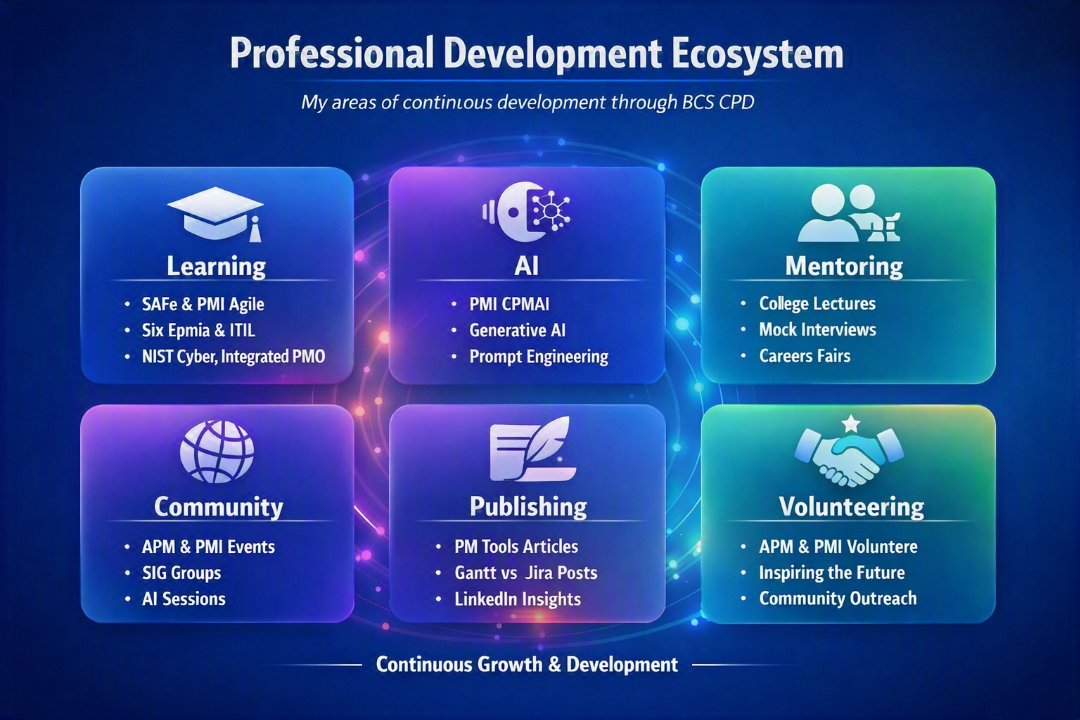
Selected examples demonstrating the practical application of project, programme and portfolio management competences across complex transformation, technology and organisational change environments.
Led a major cyber security uplift programme, coordinating governance, risk management and assurance activities across a complex and highly regulated environment.
Led a major cyber security uplift programme within a highly regulated and complex enterprise environment, coordinating governance, risk, assurance and delivery across multiple technology and business stakeholders. The programme required the organisation to strengthen its security posture while maintaining operational continuity and aligning delivery with recognised security frameworks and regulatory expectations. ⚠️ The Challenge The organisation needed to improve cyber resilience, strengthen governance and assurance, and address security risks across a complex technology estate without disrupting critical services. 🎯 My Mandate I provided programme leadership across governance, risk, assurance, planning and delivery, creating the structure required to coordinate multiple workstreams and maintain executive visibility of security outcomes. 🛡️ 1. Security Transformation Coordinated a broad cyber uplift covering security capabilities, risk reduction, resilience and control improvement, aligning technical delivery with organisational security objectives. 📘 2. Governance & Assurance Established structured governance, risk and assurance mechanisms to provide transparent oversight of programme progress, dependencies, risks and decisions. Delivery was aligned with recognised frameworks including NIST CSF and relevant security and regulatory requirements. 🤝 3. Stakeholder Leadership Coordinated technical teams, security specialists, business stakeholders and senior leadership, translating complex cyber risks into clear programme priorities, decisions and measurable delivery outcomes.
A presentation and supporting material demonstrating the approach taken to cyber security transformation, programme governance, risk management and delivery assurance.
View playbookDetailed supporting evidence describing the programme challenge, delivery approach, governance, risk management and outcomes.
View supporting document“I led a multi‑stream workplace, infrastructure and security uplift for Gateley, modernising device builds, identity and access management, endpoint security, collaboration tooling and operational readiness across the firm’s national footprint. The programme delivered a secure, modern and consistent workplace platform aligned to cloud‑ready operating models.”
The engagement required coordinated delivery across multiple teams, vendors and operational groups — ensuring consistent standards, predictable rollout and uplifted BAU capability across all Gateley offices.
🏢 Programme Overview
Full programme overview, delivery model, outcomes and technical uplift.
View supporting document“I designed and authored the full ‘Leading & Maturing a Modern PMO’ course, published on OpenLearn (Open University) and delivered through Moodle. The course provides a structured, practical and capability‑focused learning pathway for PMO professionals, covering governance, assurance, maturity uplift, service design and leadership.”
The course is built on real PMO delivery experience and aligned to APM Competence Framework principles, providing learners with actionable tools, templates, frameworks and development guidance.
📘 Course Overview
Full course delivered through Moodle and OpenLearn.
Open Moodle Course Open Base44 CourseDetailed PMO capability, governance and maturity guidance.
View supporting document“I delivered programme leadership and workplace transformation for Linklaters, modernising global infrastructure, device management, collaboration tooling and security controls across multiple international offices. The programme uplifted operational capability, strengthened identity and access management, and aligned workplace services to cloud‑ready operating models.”
The engagement required multi‑region coordination, governance, testing, deployment, and transition into BAU operations — ensuring consistent standards and predictable delivery across all global offices.
🌍 Global Overview
Full programme overview, global delivery model, outcomes and technical uplift.
View supporting document“I designed and built a modern Continuing Professional Development (CPD) application that connects competency frameworks, CPD activity, evidence capture and development planning into one mobile‑ready platform. The CPD App was created to solve long‑standing gaps in professional development tools, providing a structured, visual and evidence‑driven way for users to manage growth.”
The project demonstrates full product lifecycle delivery: identifying a problem, shaping the proposition, designing the experience, building the application, testing with users, preparing for launch and defining a future roadmap.
As Senior IT Programme Manager and product creator, I built the CPD App to address the limitations of traditional CPD systems — fragmented tools, lack of evidence capture, no competency linkage, and poor mobile usability. The CPD App integrates competency mapping, CPD logging, evidence capture and development planning into a single, dynamic ecosystem. 📘 Executive Summary
Full detail covering competency mapping, CPD logging, evidence capture, UX design and roadmap.
View supporting documentExplore the live CPD App built on Base44 — competency mapping, CPD logging, evidence vault and development planning.
Open CPD App“I delivered the complete IT infrastructure for the London 2012 Olympic Games across 3 main London sites and 4 UK‑wide hubs. The programme required building a fully operational environment on an immovable deadline, ensuring flawless performance throughout the Games, and executing a clean, risk‑free decommissioning immediately afterwards.”
The engagement demonstrates large‑scale infrastructure delivery, multi‑vendor coordination, critical‑path scheduling, operational readiness, and structured retirement of short‑term infrastructure under high public visibility.
🏗️ Infrastructure Build
Full detail covering infrastructure build, critical‑path delivery, multi‑site coordination and decommissioning.
View supporting document“I directed medium‑to‑large ServiceNow programmes across public and private sector organisations, transforming standalone ITSM deployments into secure, scalable enterprise service‑management ecosystems. Delivered ITSM, ITOM, CMDB, SecOps, Risk, App Engine and enterprise integrations, supported by structured programme governance and disciplined delivery control.”
The programmes strengthened service‑management maturity, improved automation, enhanced cyber resilience and established repeatable delivery frameworks aligned to ITIL, ISO 27001 and NIST.
As ServiceNow Delivery Manager, I governed multi‑disciplinary programmes spanning platform implementation, infrastructure operations, cybersecurity, compliance and enterprise integrations. Delivery combined programme governance, technical leadership and stakeholder alignment across the full lifecycle — from discovery and design through implementation, integration and operational adoption. ⚙️ Core ServiceNow Implementation
Full detail covering ITSM, ITOM, CMDB, SecOps, App Engine, integrations and programme governance.
View supporting document“I delivered the full Service Transition of SalesForce into Version One’s Managed Services environment, establishing stable BAU operations, structured ITSM alignment, controlled go‑live governance and predictable support readiness. The transition reduced early‑life incidents and ensured SalesForce could be supported reliably within a regulated enterprise service model.”
The engagement delivered operational readiness, knowledge transfer, acceptance criteria, governance controls and a stable long‑term support model.
This engagement represented a full transition of SalesForce capabilities into Version One’s Managed Services environment. The programme delivered operational readiness, ITSM alignment, governance controls, knowledge transfer and structured acceptance criteria to ensure SalesForce could be supported reliably within a regulated enterprise service model. 🧭 Operational Readiness
Full detail covering operational readiness, ITSM alignment, governance and BAU handover.
View supporting document“I delivered enterprise-grade ServiceNow development and bi-directional ITSM integration across public and private sector organisations. This included custom module development, automated workflows, CMDB synchronisation, legacy ITSM integration and unified reporting — enabling mature, scalable and data-driven service operations.”
The programme strengthened service-management maturity, improved automation, reduced manual effort and delivered consistent ITSM processes across complex multi-vendor environments.
As Transition Manager, I led multiple ServiceNow development and integration initiatives, enabling unified service management across diverse enterprise environments. The work focused on extending platform capability, integrating legacy ITSM systems, improving automation and delivering consistent, standardised processes aligned to ITIL and ISO 27001. ⚙️ Platform Development
Full detail covering platform development, ITSM integration, automation and CMDB synchronisation.
View supporting document“I delivered structured Service Transition Management to ensure new projects, services and technical capabilities were safely embedded into Business‑as‑Usual operations. This included operational readiness, ITSM alignment, governance, hypercare and controlled activation of new services.”
The transition framework reduced early‑life incidents, strengthened BAU support capability and ensured predictable, well‑governed handover into operations.
Service Transition ensured that new services, projects and technical changes were introduced into BAU without disruption. This included readiness assessments, ITSM alignment, stakeholder coordination and structured governance to ensure safe activation. 🧭 Operational Readiness
Full detail covering operational readiness, ITSM alignment, governance and BAU handover.
View supporting document“I delivered London Luton Airport’s cyber‑modernisation programme, uplifting identity security through MFA, Privileged Access Management, Single Sign‑On, Conditional Access and Azure AD hardening. The programme strengthened authentication, protected privileged accounts and improved compliance with aviation‑sector security standards.”
The programme established a secure identity‑management ecosystem and laid the foundation for future Zero‑Trust architecture.
London Luton Airport required a modern identity‑security framework capable of protecting critical aviation systems and supporting secure operational access. I led the MFA, PAM and SSO uplift across Azure AD, delivering strengthened authentication, privileged‑access protection and improved compliance. 🔍 Discovery & Assessment
Full detail covering MFA, PAM, SSO, Conditional Access and identity‑security uplift.
View supporting document“I delivered Unipart’s enterprise Server & Application Virtualisation Programme, modernising datacentre operations, consolidating physical servers and unifying Hyper‑V, VMware, Citrix Presentation Server, App‑V and NetScaler into a cohesive virtualised architecture.”
The programme strengthened resilience, improved application delivery, reduced operational cost and established a scalable foundation for future cloud adoption.
Unipart required a modernised datacentre environment capable of supporting scalable, resilient and centrally managed server and application workloads. I led the virtualisation programme across Hyper‑V, VMware, Citrix, App‑V and NetScaler, delivering unified management, improved performance and future‑ready infrastructure. 🖥 Server Virtualisation & P2V Migration
Full technical detail covering Hyper‑V, VMware, Citrix, App‑V, NetScaler and P2V migration.
View supporting document“I deliver campus‑wide technology transformations that modernise collaboration, connectivity and operational efficiency under strict time constraints.”
This programme modernised Newcastle University’s digital environment across multiple campuses and student halls, delivering Teams Rooms, Managed Print, wireless AP deployment, backend server builds, application configuration and unified policy frameworks — all completed ahead of the new academic term.
Newcastle University undertook a major technology transformation programme to modernise collaboration, connectivity and print infrastructure across its academic and residential estate. Delivered under strict time pressure, the initiative provided a unified digital environment powered by Teams Rooms, Managed Print and enterprise wireless. ⚠️ The Challenge The university needed to modernise collaboration tools, refresh print services and upgrade wireless connectivity across multiple campuses — all before thousands of students returned for the new academic term. The programme required precise coordination, parallel workstreams and zero disruption. 🎯 My Mandate Deliver a multi‑discipline campus transformation covering Teams Rooms deployment, Managed Print refresh, wireless AP rollout, backend server builds, application configuration and policy creation — all aligned to term‑start readiness. 🎥 Teams Rooms Deployment Designed and implemented Microsoft Teams Rooms across lecture theatres, meeting spaces and collaboration hubs, fully integrated with Microsoft 365.
Full case study describing Teams Rooms, Managed Print, wireless AP deployment and backend infrastructure uplift.
View supporting document“I led PMO governance and delivery oversight across one of the UK Government’s most complex multi‑MSP environments, operating across Official, Secret and Top Secret domains. Strengthened assurance, uplifted delivery performance and improved service‑integrator alignment across global operations.”
The PMO unified governance, risk control, reporting and supplier coordination, ensuring predictable delivery into BAE Systems as the service integrator.
The FCDO required a secure, structured and integrated PMO capability to coordinate delivery across multiple Managed Service Providers (MSPs) and ensure alignment with BAE Systems’ service‑integrator model. Operating across classified domains, the PMO provided governance, assurance, risk control and portfolio visibility. 🏛 Multi‑MSP & Service‑Integrator Coordination
Full PMO governance, assurance and multi‑MSP coordination detail.
View supporting document“I delivered a global Windows 11 deployment for United Utilities, supported by Intune, Autopilot and a new Azure identity and security build. The programme modernised endpoint management, strengthened Zero Trust security and enabled a cloud‑connected, future‑ready workplace across corporate and field operations.”
The engagement uplifted identity, compliance, provisioning and endpoint security through Azure AD, Intune, Autopilot and Windows 11 — establishing a scalable foundation for future digital‑workplace transformation.
United Utilities required a modern, secure and cloud‑connected workplace capable of supporting distributed operations. I led the Azure identity build, Intune configuration, Autopilot provisioning and Windows 11 rollout across corporate and field sites. ☁️ Azure Identity & Security Build
Full Azure identity build, Intune configuration, Autopilot provisioning and Windows 11 deployment detail.
View supporting document“I established and led a centralised PMO function for NFU Mutual, enhancing governance, portfolio visibility, resource optimisation and delivery assurance across business change, technology and compliance programmes within a regulated financial‑services environment.”
The engagement delivered a mature, commercially disciplined PMO service that strengthened decision‑making, improved delivery predictability and embedded a sustainable governance framework.
NFU Mutual required a structured, transparent and commercially aware PMO function to support its growing change portfolio across business, IT and regulatory programmes. I was engaged to establish the PMO, uplift governance, improve reporting accuracy and strengthen portfolio‑level decision‑making. 📑 PMO Establishment & Governance Framework
Full PMO establishment, governance uplift and portfolio‑management detail.
View supporting document“I delivered a full PMO service review for Dounreay Nuclear, assessing governance, delivery capability, vendor coordination and portfolio performance within a complex multi‑supplier environment. The engagement strengthened assurance, improved delivery predictability and uplifted PMO maturity across engineering, IT and infrastructure workstreams.”
Operating within a regulated nuclear environment, the role demanded rigorous governance, commercial awareness and strategic leadership across a multi‑vendor, service‑integrator delivery model.
As PMO Manager at Dounreay Nuclear, I was engaged to assess, stabilise and enhance the organisation’s project management service capability within a multi‑vendor service‑integrator model. ⚠️ Initial Service Review & Assessment Conducted a comprehensive PMO service assessment, evaluating structure, processes, governance maturity and alignment with organisational objectives.
Full PMO service review including governance uplift, portfolio management and commercial stewardship.
View supporting document“I supported the multi‑year migration of Aviva’s life & pensions book of business into AdminRe / Swiss Re’s in‑house Alpha platform — delivering large‑scale data migration, legacy system integration, COBOL/VB development and monthly Agile releases tied to contractual financial obligations.”
The programme delivered a robust, compliant and scalable life & pensions platform, improving operational efficiency, data integrity and long‑term service capability.
AdminRe / Swiss Re embarked on a multi‑year, large‑scale transformation programme to transfer the Aviva book of business into its in‑house “Alpha” life and pensions platform. This complex initiative combined legacy system integration, software development and extensive data migration — all underpinned by a disciplined Agile release framework. ⚠️ The Challenge The migration required synchronised delivery across multiple legacy systems, high‑volume data transfer, reconciliation, and continuous functional enhancements — all tied to contractual financial obligations and monthly release cycles. 🎯 My Mandate Support data migration, testing, release governance, dependency management and multi‑system delivery coordination across COBOL, VB, Alchemy and Unix components. 📑 Data Migration & Reconciliation
Full programme description including data migration, testing and Agile release governance.
View supporting document“I led AstraZeneca’s cloud‑migration pre‑sales engagement — shaping discovery, solution architecture and commercial modelling to deliver a secure, scalable and compliant hybrid‑cloud migration proposal.”
The engagement positioned AstraZeneca to transition from legacy infrastructure to Azure‑based cloud services aligned with its global digital‑transformation roadmap.
As part of the Pre‑Sales Team, I led the initial engagement with AstraZeneca to design and cost a strategic programme to migrate its on‑premises server estate to a cloud‑hosted environment. 🧭 Tender Stage – Discovery & Requirements
Full pre‑sales engagement including discovery, architecture and commercial modelling.
View supporting document“I strengthened SSE Electricity’s enterprise data‑protection posture through DLP policy configuration, agent deployment and Splunk analytics design — improving monitoring, detection and incident‑response capability across operational and corporate environments.”
The programme uplifted SSE’s security maturity, delivering structured protection controls, reliable telemetry and actionable analytics for security operations.
The SSE Electricity programme focused on strengthening enterprise data protection and operational security through DLP configuration, agent deployment and Splunk analytics design. ⚠️ The Challenge SSE required a consistent, compliant and scalable data‑protection model capable of detecting and preventing data leakage across a diverse estate. 🎯 My Mandate Deliver DLP configuration uplift, deploy agents across critical endpoints, and design Splunk dashboards to improve visibility and incident response. 📑 DLP Configuration & Policy Design
Full programme description including DLP uplift, agent deployment and Splunk analytics.
View supporting document“I deliver global cloud‑transformation programmes that modernise infrastructure, accelerate SaaS adoption and enable secure, scalable data migration.”
This programme modernised Telefónica’s enterprise estate across 46,000 devices and 750 locations, introducing multi‑region AWS foundations, SaaS development, microservices integration, global data migration and unified operational governance.
The Telefónica Global Infrastructure Transformation Programme delivered a unified, cloud‑native foundation across 46,000 end‑user devices spanning 750 locations and multiple countries. It modernised core infrastructure, accelerated SaaS adoption and enabled secure, scalable data migration to AWS. ⚠️ The Challenge Telefónica’s legacy infrastructure lacked the elasticity, resilience and global scalability required to support rapid growth and distributed operations. A cloud‑first architecture was needed to unify platforms, reduce cost and improve performance across continents. 🎯 My Mandate Deliver a multi‑region AWS transformation covering infrastructure modernisation, SaaS development, microservices integration, global data migration, end‑user estate uplift and operational governance. ☁️ AWS Infrastructure Modernisation Designed and deployed multi‑region AWS environments supporting compute, storage and networking workloads. Introduced Infrastructure‑as‑Code using Terraform and CloudFormation for repeatable, compliant provisioning.
Full case study describing AWS uplift, SaaS development, global data migration and operational governance.
View supporting document“I led the turnaround of a failing PMO delivery service for Eversheds Sutherland plc — stabilising governance, reporting, assurance and delivery processes, and later operating as PMO Manager to embed long‑term maturity.”
The PMO was transformed from an underperforming function into a stable, predictable and value‑adding governance service supporting complex legal‑sector delivery.
When I was first engaged by Eversheds Sutherland plc, the organisation’s PMO delivery service was struggling to meet expectations. Governance, reporting, assurance and delivery processes were inconsistent, reactive and lacked the structure required to support a complex legal‑sector portfolio. ⚠️ The Challenge The PMO lacked governance discipline, structured reporting, risk management and delivery oversight — resulting in low confidence, poor visibility and inconsistent project outcomes. 🎯 My Mandate Stabilise the PMO, rebuild governance and assurance frameworks, redesign reporting, restore stakeholder confidence and deliver a predictable PMO service. 📑 Phase 1 — Rapid Assessment & Stabilisation I conducted a rapid assessment of PMO gaps, failure points and operational weaknesses, establishing immediate stabilisation measures.
Full programme description including turnaround approach, governance uplift and service delivery.
View supporting document“I led the design and implementation of a unified Central PMO (CPMO) service for European operations — establishing ISO‑aligned governance, GDPR‑compliant processes, commercial models and capability frameworks to support multinational clients.”
The CPMO initiative delivered a scalable, compliant and high‑performance PMO model capable of supporting diverse client environments across multiple jurisdictions.
As European Central PMO Lead, I was responsible for identifying, designing and implementing a unified CPMO service based out of Belgium to support European clients. The initiative established a scalable, compliant and high‑performance PMO model aligned with ISO, GDPR and secure client requirements. ⚠️ The Challenge European delivery required a single PMO model capable of operating across multiple jurisdictions, regulatory environments and client contexts — while maintaining ISO, CMS and GDPR compliance. 🎯 My Mandate Lead CPMO service design, governance creation, compliance alignment, commercial modelling, capability development and platform ownership — ensuring the PMO was secure, scalable and auditable. 📑 Service Design & Compliance Designed a compliant PMO operating model embedding ISO quality standards, CMS alignment, GDPR privacy‑by‑design principles and secure client data handling.
Full programme description including governance, compliance, commercial modelling and capability development.
View supporting document“I led delivery governance, technical assurance and operational readiness across a multi‑phase MoD programme migrating Exchange 2007 → 2013 → 2016, ensuring continuity, compliance and zero disruption to mission‑critical communications.”
The programme modernised Defence messaging infrastructure through phased coexistence, secure migration sequencing, and full decommissioning of legacy platforms — strengthening resilience, security and operational agility.
The Ministry of Defence undertook a complex, multi‑phase programme to modernise its messaging and collaboration infrastructure. The initiative transitioned the organisation from Exchange 2007 to Exchange 2016, using Exchange 2013 as an intermediary platform to maintain service continuity and compliance across secure environments. ⚠️ The Challenge Defence communications cannot fail. The migration had to maintain operational readiness across classified and non‑classified networks, ensure coexistence between three generations of Exchange, and deliver zero downtime for mission‑critical services. 🎯 My Mandate Provide delivery leadership, governance discipline, technical assurance and risk control across all phases — ensuring the migration strategy was secure, compliant, sequenced correctly and fully aligned with Defence Digital standards. 📑 Phase 1 — Assessment & Planning I supported the initial audit and planning activities, ensuring migration sequencing, coexistence strategy and risk mitigation were fully documented and approved.
Full programme description including phases, coexistence strategy, migration sequencing and outcomes.
View supporting document“I lead the commercial and technical shaping of Device Lifecycle Management solutions — transforming RFP responses into fully governed, contract‑ready delivery models.”
The Device Lifecycle Management model empowers organisations to optimise their workplace device estate through a structured, end‑to‑end process: Inform → Procure → Support → Recover. I ensure each bid is compliant, compelling, commercially viable and operationally deliverable.
The Device Lifecycle Management solution enables organisations to take control of their workplace device estate through a structured, end‑to‑end model. As part of the Pre‑Sales team, I shape this solution commercially and technically — from initial RFP/ITT response through to final contract negotiation and Statement of Work (SoW) creation. ⚠️ The Challenge Organisations require a scalable, governed lifecycle model that aligns with procurement, logistics, support and recovery processes. Each tender demands precise requirement analysis, lifecycle alignment, commercial modelling and technical validation — all under strict governance and evaluation criteria. 🎯 My Mandate Lead the full pre‑sales lifecycle: requirement analysis, solution shaping, SME collaboration, cost modelling, governance compliance, down‑selection refinement, negotiation and BAFO submission — ensuring the final solution is contract‑ready and operationally deliverable. 📑 Bid Response & Tender Stage I coordinate the full RFP/ITT response, ensuring the proposal is compliant, compelling and aligned to the Inform → Procure → Support → Recover lifecycle.
Full case study describing bid response, solution shaping, negotiation and lifecycle alignment.
View supporting document“I deliver large‑scale end‑user transformation programmes that modernise desktop estates, strengthen security posture and unify device management.”
This programme upgraded 32,000 devices across the Home Office’s national estate, introducing modern Windows 10 capabilities, cloud management, identity uplift and secure remote‑working.
The UK Home Office embarked on a major end‑user technology transformation, upgrading 32,000 devices across its national estate to Windows 10. The programme modernised the desktop environment, strengthened security, and introduced cloud‑based management and storage capabilities through SCCM, Intune and Azure integration. ⚠️ The Challenge A large, distributed estate running legacy Windows versions required uplift to a secure, modern platform — without disrupting critical national operations. The programme needed to unify device management, strengthen security, and support remote‑working across multiple agencies. 🎯 My Mandate Deliver a structured, multi‑phase Windows 10 transformation covering device upgrade, SCCM/Intune integration, cloud storage enablement, identity uplift, operational tooling enhancement, user adoption and security alignment. 💻 Device Upgrade Migrated 32,000 endpoints from Windows 7/8 to Windows 10, ensuring compatibility with modern applications, security baselines and operational tooling. 🔧 SCCM & Intune Integration Implemented hybrid management architecture enabling automated deployment, patching, compliance enforcement and secure configuration. ☁️ Cloud Storage Enablement Introduced secure OneDrive and Azure‑based storage solutions, reducing reliance on on‑premises infrastructure and improving mobility. 🔐 Identity & Access Management Strengthened authentication and policy enforcement through Azure AD, conditional access and modern identity controls. 🛠️ Operational Tooling Enhanced service‑management tooling for incident, request and change processes, improving operational efficiency and visibility. 📣 User Adoption & Training Delivered communication campaigns, training sessions and early‑life support to ensure smooth transition and minimise disruption. 📊 Governance & Reporting Established dashboards for rollout progress, compliance, security posture and user satisfaction metrics. 🛡️ Security & Compliance Alignment Windows 10’s security framework was mapped directly to Home Office risk and compliance standards. Introduced TPM 2.0, BitLocker encryption and advanced identity management, strengthening endpoint protection across all operational sites.
Full case study describing rollout approach, security uplift, cloud integration and operational impact.
View supporting document“I deliver strategic secondments that uplift service maturity, strengthen governance, and enhance commercial performance across enterprise programmes.”
My secondments span service transition, transformation delivery, ServiceNow project management, European PMO leadership and pre‑sales solution architecture.
During my tenure at Computacenter, I undertook multiple high‑impact secondments across service transition, transformation, ServiceNow enablement, European PMO leadership and pre‑sales solution design. Each role contributed directly to operational maturity, commercial growth and customer success. 🧩 1. Service Transition & Transformation Delivery Manager Delivered complex service transitions and transformations for new and existing managed‑service customers, ensuring seamless onboarding, operational readiness and service stability.
Full case study describing transition, transformation, PMO leadership and pre‑sales solution delivery.
View supporting document“I deliver multi‑workstream enterprise transformation that modernises infrastructure, strengthens resilience and improves service delivery.”
I lead structured programmes that uplift core platforms, collaboration tools, identity services and ITSM operations across large public‑sector estates.
The Department for Work and Pensions (DWP) undertook a comprehensive enterprise IT transformation programme to modernise infrastructure, enhance service delivery and strengthen operational resilience across its national footprint. Multiple concurrent workstreams delivered a unified, secure and scalable digital environment. ⚠️ The Challenge DWP’s legacy platforms, collaboration tools, wireless estate, SQL environments and service‑management systems required modernisation. The challenge was to uplift multiple critical services simultaneously without disrupting public‑service delivery, while ensuring compliance with government resilience and security standards. 🎯 My Mandate Deliver a multi‑workstream transformation portfolio covering SQL upgrades, workspace management, unified communications, managed print, SharePoint development, BC & DR uplift, identity lifecycle improvements, wireless modernisation and ITSM integration. 🧩 1. SQL Upgrade Upgraded legacy SQL environments to supported versions, improving performance, security and maintainability. Delivered automated migration scripts, schema validation and post‑upgrade optimisation. 📅 2. Condeco Rollout Implemented Condeco workspace management across DWP sites, enabling intelligent desk booking, meeting‑room scheduling and occupancy analytics with AD and Exchange integration. 💬 3. Unified Communications Transitioned from Microsoft Communicator and Lync to Microsoft Teams, delivering secure voice, video and messaging capabilities with enterprise‑grade reliability. 🖨️ 4. Managed Print Services Deployed a consolidated Managed Print solution with secure print release, cost tracking and sustainability reporting — reducing print volume and operational overhead. 📁 5. SharePoint Development Delivered customised SharePoint Online sites with metadata‑driven search, workflow automation, version control and Power Automate integration. 🛡️ 6. Business Continuity & Disaster Recovery Designed and tested BC & DR frameworks, including failover simulations and recovery validation, improving RTOs and compliance with government resilience standards. 👤 7. Quest Deployment Implemented Quest migration and identity‑management tools to support AD consolidation, user provisioning and lifecycle management. 📶 8. Wireless Access Point Deployment Rolled out enterprise‑grade wireless access points with NAC integration and centralised monitoring for secure, high‑performance connectivity. 🔧 9. ITSM Integration Unified multiple service‑management platforms into a single ITSM ecosystem using ServiceNow for incident, change and asset management — improving SLA compliance and operational transparency.
Full case study describing transformation approach, workstreams, governance and outcomes.
View supporting document“I deliver global end‑user technology transformations that modernise devices, uplift security and enable cloud‑connected digital workplaces.”
I lead structured rollout and adoption programmes that ensure users transition smoothly to modern operating systems, strengthened security baselines and improved digital‑workplace capabilities.
HSBC undertook one of the largest end‑user technology upgrades in its history — a global rollout of Windows 11 to 46,000 users across 750 locations. The programme modernised the desktop experience, uplifted security baselines and enabled a more agile, cloud‑connected workforce aligned with HSBC’s digital‑banking vision. ⚠️ The Challenge HSBC’s legacy desktop estate required modernisation to support new digital capabilities, enhanced security controls and improved performance. The challenge was to deliver a global operating‑system upgrade without disrupting business‑critical financial operations, while ensuring employees understood and adopted new Windows 11 features. 🎯 My Mandate Deliver a global Windows 11 rollout, refresh legacy devices, uplift security baselines, integrate rollout workflows into ServiceNow, deliver multilingual adoption programmes and establish global governance and reporting for progress, compliance and user satisfaction. 🧩 1. Global Deployment Delivered Windows 11 to 46,000 users across 750 locations worldwide through structured regional waves, ensuring minimal disruption and full compliance with HSBC’s security and regulatory standards. 💻 2. Modern Device Refresh Replaced legacy hardware with secure, high‑performance devices optimised for Windows 11, improving endpoint stability and user experience. 🔐 3. Enhanced Security Baselines Implemented TPM 2.0, BitLocker and advanced identity‑management controls aligned with HSBC’s global cybersecurity policies. 🔧 4. ServiceNow Integration Automated incident, request and change workflows for rollout tracking, compliance reporting and support. 🌍 5. User Adoption Programme Delivered multilingual training, digital champions network and feedback loops to ensure employees understood new Windows 11 features such as Snap Layouts, Teams integration and enhanced security controls. 📈 6. Performance & Reliability Improvements Reduced boot times, improved endpoint stability and enhanced remote‑work experience across global regions.
Full case study describing rollout approach, adoption strategy, security uplift and outcomes.
View supporting document“I deliver global digital‑workplace transformations that modernise collaboration, uplift user experience and embed new ways of working.”
I lead structured adoption programmes that ensure users embrace modern tools, retire legacy systems, and transition smoothly to cloud‑based collaboration platforms.
Deutsche Bank required a modern, unified collaboration ecosystem to replace fragmented legacy telephony and conferencing platforms. The organisation needed a global rollout of Microsoft Teams and a structured adoption strategy to ensure 16,000 employees embraced new digital ways of working. ⚠️ The Challenge Legacy systems created inconsistent user experience, operational overhead, and limited integration with modern digital workplace tools. The challenge was not only technical migration but cultural change — ensuring users adopted Teams as the central hub for chat, voice, video and document collaboration. 🎯 My Mandate Deliver a global M365 transformation programme: retire legacy platforms, deploy Teams Voice & Meetings, embed workflows into ServiceNow, uplift reliability and performance, and execute a structured user‑adoption strategy across global offices. 🧩 1. Unified Communications Transition Retired legacy telephony and conferencing platforms, migrating all users to Teams Voice and Teams Meetings as the unified communications backbone. 📘 2. User Adoption Strategy Delivered structured training, champions network, multilingual support, and targeted communications to ensure employees embraced new ways of working. 🔧 3. ServiceNow Integration Embedded Teams and M365 workflows into ServiceNow, enabling streamlined IT support, request management and improved operational efficiency. 📈 4. Performance & Reliability Improvements Delivered measurable gains in uptime, call quality, collaboration speed and overall digital‑workplace reliability. 💰 5. Cost Optimisation Achieved significant cost reductions through platform consolidation, licence rationalisation and removal of redundant legacy systems. 🤝 6. Change Enablement Partnered with business units globally to ensure smooth transition, sustained engagement and long‑term adoption post‑go‑live.
Full case study describing rollout approach, adoption strategy, integration and outcomes.
View supporting document View powerpoint“I deliver infrastructure upgrades that strengthen security, resilience and future‑readiness in regulated environments.”
I lead controlled, risk‑managed technical uplift programmes that modernise core identity platforms without disrupting business‑critical financial operations.
Santander required a modern, secure and compliant Active Directory Domain Controller (AD DC) environment to support future identity, security and cloud initiatives. The upgrade needed to be executed across multiple sites with zero downtime to financial‑services operations. ⚠️ The Challenge Legacy domain controllers were running outdated OS versions and older AD DS functional levels. This limited authentication capability, replication efficiency and alignment with Microsoft’s enterprise standards. The upgrade had to be delivered safely, predictably and in line with Santander’s governance and compliance frameworks. 🎯 My Mandate Upgrade all in‑situ domain controller servers to Windows Server 2008 R2, promote forest and domain functional levels, validate schema and replication health, and ensure full compliance with Santander’s security and audit requirements. 🧩 1. Server OS Upgrade Transitioned legacy DC servers to Windows Server 2008 R2, improving patch compliance, performance and security posture across the AD estate. 📘 2. Functional Level Promotion Elevated AD DS forest and domain functional levels to unlock enhanced authentication, replication and policy features, enabling modern identity‑management capabilities. 🔍 3. Testing & Validation Delivered schema verification, replication health checks, multi‑site testing and pre‑production validation to ensure stability and readiness before promotion. 🤝 4. Stakeholder Coordination Worked with infrastructure, security and compliance teams to align technical changes with Santander’s governance framework and ensure controlled upgrade windows. 🛡️ 5. Risk Mitigation Implemented rollback plans, validation checkpoints and controlled execution windows to ensure zero downtime during upgrade activities.
Full case study describing upgrade approach, validation, governance and outcomes.
View supporting document“I lead large‑scale managed services transitions that deliver stability, resilience and predictable global operations.”
I deliver multi‑tower transformation programmes that modernise service operations, uplift capability, and ensure zero disruption to business‑critical environments.
Synchrony required a modern, resilient global managed services model capable of supporting 125,000 users across the US, India and the Philippines. The organisation needed a controlled transition from the incumbent MSP to a new integrated service model — without disrupting regulated financial operations. ⚠️ The Challenge Synchrony’s legacy service model lacked consistency, automation, and global alignment. The transition had to be executed across multiple towers (Service Desk, ITSM, Telephony, Networking, Wintel, Security, Data Centre, Supply Chain) while maintaining uninterrupted service availability for financial operations. 🎯 My Mandate Deliver a 2‑year global transition and transformation programme underpinning a 5‑year managed services contract. Establish a unified ITSM platform, modernise end‑user technology, uplift infrastructure towers, and build a 24/7 global service desk operating across three continents. 🧩 1. Global Service Operations Delivered a 24/7 Global Service Desk, unified ServiceNow ITSM platform, and modernised telephony/contact‑centre systems aligned to financial‑sector compliance. Established predictable global operational rhythm across time zones. 📘 2. Incremental Service Go‑Lives Structured phased activation of each tower: early stabilisation of Service Desk, Telephony and ITSM; controlled cutovers for Networking, Wintel and Security; sequenced delivery of high‑risk components including Data Centre Migration and Supply Chain. 🤖 3. Digital Experience & Automation Introduced multilingual chatbot (English & Mandarin), automated ServiceNow workflows, and user‑adoption programmes to modernise engagement and reduce operational load. 💻 4. End‑User Technology & Supply Chain Delivered global device refresh with secure builds, redesigned supply chain model for predictable fulfilment and lifecycle management, and structured communication plans to support smooth transitions. 🏛️ 5. Infrastructure & Platform Transformation Migrated data centres to modern secure platforms, uplifted Networking, Wintel and Security services, and integrated new MSP capabilities into Synchrony’s enterprise architecture. 📑 6. ITSM Excellence & Governance Established end‑to‑end Incident, Request, Change, Problem and Major Incident Management, unified service catalogue, operational playbooks, and structured transition framework ensuring predictable handover into BAU.
Full case study describing transition, transformation, governance and outcomes.
View supporting document“I ensure services move from project to BAU without disruption.”
I deliver structured, risk‑managed service transition that protects stability, cost, customer experience and operational readiness.
Many organisations treat service transition as a final checklist before go‑live. This creates operational risk that persists long after implementation. ⚠️ The Challenge Weak transition resulted in incomplete documentation, unclear ownership, missing runbooks, and unstable post‑go‑live operations. 🎯 My Mandate Build a mature transition model that ensures operational readiness, stable adoption, and clear ownership across service, operations and support. 🧩 1. Operational Readiness Introduced structured readiness assessments with pass/fail criteria, ensuring BAU teams were fully prepared before go‑live. 📘 2. Documentation & Support Models Delivered complete runbooks, support tiers, escalation paths, and ownership models aligned to ITIL service management. 🤝 3. Knowledge Transfer Embedded training, walkthroughs, and early BAU engagement from design stage to ensure seamless handover.
Detailed supporting evidence describing transition approach, readiness, governance and outcomes.
View supporting documentDelivery of a secure, modern public‑sector cloud platform supporting thousands of users, diverse devices and mission‑critical applications across a nationwide encrypted WAN.
Programme leadership across architecture, security, multi‑supplier integration and end‑to‑end service delivery within a regulated, high‑risk environment.
⚠️ The Challenge The MET required a complete redesign of its legacy infrastructure. The estate suffered from fragmented systems, inconsistent security controls, ageing devices, siloed application access and increasing pressure to meet stringent government security standards. A secure, scalable, cloud‑based platform was needed to support thousands of users across a protected national WAN. 🎯 Programme Mandate Design, build and implement a secure public‑sector cloud environment, deliver end‑to‑end secure digital services, integrate critical business applications from multiple delivery partners, and ensure full compliance with government security and operational standards. 🧩 1. Platform Architecture & Design Engineered a secure cloud‑based platform forming the foundation for all services. Delivered secure hosting, unified device ecosystem, encrypted WAN connectivity, centralised identity & access management, and an interoperability framework enabling seamless access to partner‑provided applications. 📘 2. Secure Digital Services Implemented secure email, remote access, mobile device management (MDM), managed & hosted device services, and integrated access to critical business applications. All services were unified under a single governance and operational model. 🤝 3. Multi‑Partner Delivery Model Led architectural governance, security assurance, infrastructure build, device rollout, application integration, testing, transition and service onboarding across multiple suppliers. Ensured consistent standards and seamless user experience.
Full case study describing architecture, security, delivery model and outcomes.
View case study PDF“I transform opportunities into validated, costed, risk‑managed, contract‑ready solutions.”
I lead full‑lifecycle pre‑sales activity blending bid leadership, solution design, commercial modelling, CADRO analysis and client negotiation.
A major client opportunity required a commercially viable, technically robust, and contract‑ready proposal within a compressed timeline. ⚠️ The Challenge The client required a complete solution architecture, service model, cost model, risk position, and SoW — all validated and ready for internal approval. 🎯 My Mandate Lead the full pre‑sales lifecycle from bid qualification through to BAFO, ensuring feasibility, profitability, and competitive positioning. 🧩 1. Requirements & Discovery Ran structured workshops to extract functional, technical, operational and commercial requirements, shaping the solution around real client needs. 📘 2. Solution & Service Design Built end‑to‑end architecture, service management model, SLAs/OLAs, support tiers, security and compliance considerations. 💰 3. Cost & Resource Modelling Produced detailed commercial models covering delivery effort, utilisation, third‑party costs, licensing, run‑costs, margin and revenue targets. 🛡️ 4. CADRO Analysis Identified constraints, assumptions, dependencies, risks, opportunities and limitations — feeding directly into commercials and governance. 🤝 5. BAFO & Negotiation Refined pricing, delivery phasing, risk positions and concessions to secure a mutually beneficial agreement.
Detailed supporting evidence describing solution design, commercials, CADRO and negotiation outcomes.
View supporting document“I lead PMO functions that strengthen governance, improve delivery confidence and provide structured oversight across complex programmes.”
I deliver portfolio‑level reporting, assurance, risk management, planning, financial tracking and stakeholder alignment to ensure predictable, controlled delivery.
As PMO Manager, I provide governance, assurance and delivery support across multi‑workstream programmes. I establish structured reporting, risk and issue management, financial oversight, planning frameworks and stakeholder engagement models that improve delivery predictability and strengthen organisational control. ⚠️ The Challenge Programmes lacked consistent governance, reporting cadence, risk visibility and delivery assurance. Stakeholders required clearer insight into progress, dependencies, financial exposure and delivery confidence. 🎯 My Mandate Build and lead a PMO function covering governance, reporting, RAID management, planning, financial tracking, resource forecasting, change control and delivery assurance — ensuring programme alignment with organisational strategy. 📊 1. Governance Framework Established governance boards, decision‑making structures, reporting cycles and escalation paths. Ensured consistent standards across all workstreams. 📈 2. Portfolio Reporting Delivered executive dashboards, milestone tracking, dependency mapping, KPIs and delivery confidence assessments. ⚠️ 3. RAID Management Implemented structured risk, issue and dependency management with clear ownership, mitigation plans and impact analysis. 💰 4. Financial Oversight Managed budgets, forecasts, burn‑rate tracking, cost‑to‑complete and financial risk exposure across the portfolio. 📅 5. Planning & Scheduling Built integrated programme plans, critical‑path analysis, resource forecasts and delivery roadmaps. 👥 6. Stakeholder Engagement Coordinated communication, alignment and decision support across senior stakeholders, delivery teams and business units. 🛡️ 7. Delivery Assurance Provided independent assurance, readiness assessments, checkpoint reviews and quality oversight to strengthen delivery confidence.
Full case study describing governance uplift, assurance, reporting and delivery support.
View supporting documentLed large-scale digital transformation initiatives within NHS England, coordinating complex technology change, stakeholder engagement and programme delivery across a highly regulated healthcare environment.
Led a multi‑trust NHS England digital transformation programme focused on modernising clinical workflows, improving data interoperability and replacing fragmented legacy systems with secure, cloud‑aligned digital platforms. Operating as Senior Programme Manager, I coordinated delivery across clinical, operational, technical and supplier teams, ensuring alignment with national standards, cyber‑security requirements and patient‑safety governance. The programme introduced new digital capabilities including electronic triage, integrated care‑record access, automated reporting and improved identity and access management. I oversaw programme governance, risk management, stakeholder engagement and delivery assurance, ensuring safe transition without disruption to critical services. The transformation delivered measurable improvements in operational efficiency, clinical safety and patient experience, while strengthening digital maturity across participating trusts and enabling future innovation.
Presentations, documents, videos and other supporting View playbook
Led a large-scale Windows device migration programme, coordinating the transition of approximately 126,000 devices while managing technology, operational and stakeholder dependencies.
Led a large-scale enterprise Windows device migration involving approximately 126,000 devices, coordinating technology, operational, deployment and stakeholder dependencies across a complex user estate. The programme required industrialised deployment at scale while maintaining business continuity, managing user impact and coordinating multiple technical and operational teams. ⚠️ The Challenge Migrating a 126,000-device estate introduced significant challenges across deployment readiness, application compatibility, infrastructure, security, user communications, support and operational continuity. 🎯 My Mandate I provided programme leadership and integrated planning across the migration, bringing together technical delivery, operational readiness, stakeholder management, risk control and deployment governance. 💻 1. Industrialised Migration Coordinated the migration of approximately 126,000 devices using structured deployment waves, readiness controls and dependency management to enable repeatable delivery at enterprise scale. 🔄 2. Technology & Operational Integration Coordinated dependencies across endpoint management, infrastructure, applications, security, identity, service management and user support to ensure the technology transition was operationally sustainable. 🤝 3. Stakeholder & Risk Management Maintained programme visibility across technical teams, business stakeholders and operational functions, using structured governance, risk management and planning to manage the complexity of a highly distributed estate.
Led cloud transformation and modernisation initiatives across complex technology environments, supporting cloud adoption, infrastructure transformation and improved operational outcomes.
Led cloud transformation and modernisation initiatives across complex enterprise technology environments, supporting adoption of Azure and AWS while aligning technology change with operational, financial and business objectives. The transformation required more than technical migration. It involved establishing the governance, planning, operating model and stakeholder alignment necessary to transition towards sustainable cloud-enabled services. ⚠️ The Challenge The organisation needed to modernise its technology estate and increase cloud adoption while controlling operational costs, managing migration risk and maintaining service continuity. 🎯 My Mandate I led programme-level coordination across cloud adoption, infrastructure transformation, governance, dependencies, risk and operational readiness, connecting technical delivery with measurable business outcomes. ☁️ 1. Cloud Adoption Supported adoption of Azure and AWS capabilities as part of a broader technology modernisation strategy, coordinating migration priorities, dependencies and delivery planning. 📊 2. Cost & Operational Optimisation Connected cloud transformation with operational improvement and financial management, helping identify opportunities to rationalise services, improve efficiency and reduce the cost of operating the technology estate. 🔐 3. Secure & Governed Transformation Ensured cloud transformation was delivered within appropriate governance, security, risk and operational controls, balancing the pace of modernisation with enterprise assurance requirements.
“I fix failing delivery environments.”
Led PMO transformation and turnaround activity, improving governance, delivery confidence, stakeholder visibility and overall programme performance across a complex portfolio.
A struggling PMO facing SLA failures, low morale, and declining client trust was transformed into a stable, high‑performing service during a critical contract renewal phase. When a managed service enters a contract renewal phase, performance becomes a commercial differentiator—not just an operational concern. ⚠️ The Challenge The PMO was experiencing systemic issues including SLA failures, low morale, poor delivery outcomes, and a breakdown in client collaboration. 🎯 My Mandate My role was to take operational control, stabilise delivery, rebuild culture, restore trust, and return the service to profitability. 🧩 1. Structured Recovery A hybrid Agile + Integrated Planning approach prioritised immediate recovery while aligning short‑term fixes with long‑term strategy. 📘 2. Governance Reset Using Six Sigma, continuous improvement, lessons learned, and ISO 27001 alignment, governance was redesigned to enable—not restrict—delivery. 🤝 3. Cultural Transformation Structured interviews and open communication rebuilt trust and restored a “one‑team” ethos.
"I create the control system that makes complex delivery predictable.”
Established and led programme governance frameworks, providing structured oversight, decision-making, assurance and stakeholder transparency across complex transformation programmes.
A PMO without structure becomes reactive, focusing on reporting rather than results. A defined operating model transforms governance into a strategic enabler—aligning governance, planning, people, and value to deliver measurable outcomes. Using the PMO Operating Model Wheel, programme governance was strengthened through confidence, consistency, and control. This included disciplined decision-making, transparent reporting, and assurance mechanisms that elevated stakeholder trust and improved delivery predictability. The governance framework became a strategic anchor for executive conversations, enabling clearer scope definition, structured oversight, and alignment between strategy and execution.
Drawing on my CPD activity and competence assessment, the following areas are prioritised for focused development over the coming year.
Current capability to target capability — prioritised across the next 12 months.